


Sanctifying Your Sundays When You Have No Mass Available.

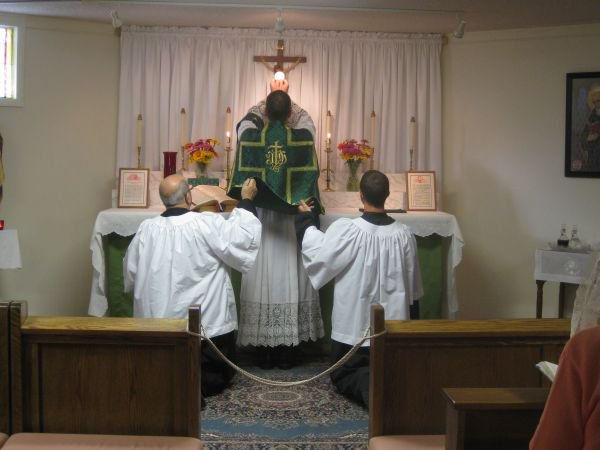
Sanctifying Your Sundays When You Have No Mass Available.
As a general rule, attending Mass every Sunday (or even every day) is excellent. But in your particular circumstances right now, if there is no Mass you can attend without compromise, then it is God’s Will that you do not attend Mass. (A Mass involves compromise—among other ways—when it is said by a liberal fraternity or priest.) Attending a compromise Mass is a sin and harms your soul. Attending such a compromise Mass because “I need my Sacraments” is merely an excuse to take the easy path and not stand firm out of love for Christ the King.
By you refusing a Mass involving compromise, God will bless you now through other means. He is not abandoning you. He is merely changing His means of sanctifying you to fit the circumstances into which He lovingly put you.
Not only now but also at various other times in history God has sanctified souls without giving them regular access to the Sacraments. Sometimes, physical persecution caused the absence of good priests and the true Sacraments. God called Japanese Catholics to this type of life for almost 300 years (1587-1873). See, Catholic Encyclopedia, article: Japanese Martyrs.
During that period,
Japan was a forbidden land, and it seemed that for once persecution had been successful in crushing out Christianity. But from time to time there came strange rumors that the Japanese Christians, deprived as they were of altars, priests, and sacrifice, were still here and there holding fast to the faith that had been preached to their fathers by St. Francis Xavier.
Victories of the Martyrs, by St. Alphonsus de Liguori, Benzinger Bros, 1887.
At other times, it has been God’s Will that Catholics in some places have been without regular access to the true Sacraments because of travel difficulties and great distances to remote locations. For example:
In one area of Ecuador which was sparsely served by priests, … Redemptorist priests went two-by-two on horseback, among a population which was completely hidden in the forests or on the crests of volcanoes. Many people, as soon as they heard [that a Catholic mission was planned], closed their cabins and walked as far as 30 miles to take part in the exercises. Where there was no church, they hastily built “green tents” made of tree branches, under which the instructions were given and enthusiastically received for fifteen days, concluded by everyone receiving the Sacraments and consecrating himself and his family to the protection of the Blessed Virgin.
When the Redemptorist Fathers had to leave, the parting was often quite heartrending—the poor people imploring them with tears to remain among them.
To those whom God Wills to be without the Sacraments for a time, He gives the incalculably precious gift of a great increase in Faith. We see that illustrated in the love and devotion of the faithful in the Ecuadorian wilderness, as recounted above.
We also see this in the Catholics living during the Masonic French Revolution, as recounted by Bishop Bruté, who lived through that period in France. Here is how Bishop Bruté described this priceless increase in Faith among the French Catholics living without the Sacraments:
How strong and imperishable was the Catholic Faith’s hold upon thousands of hearts; how fervently did every true Christian family pledge its love and life to our blessed Lord; how constantly did Christian mothers require of their offspring, that, no matter what happened, they would never forget their duty to God. With how much anxiety, and yet fidelity, did they endeavor, especially on Sundays, to supply the want of public exercises of Religion and sanctify the day in their family.

Comentários